

The Ka-Bar Becker BK18 sits in a category that’s surprisingly hard to get right: the survival-tactical hybrid. In this Ka-Bar Becker BK18 review, I spent several months carrying and using the blade on camping trips, carving sessions, and basic field tasks to see if it truly earns its reputation.
The collaboration between KA‑BAR and designer Ethan Becker has produced some of the most respected outdoor blades on the market. The BK18 Harpoon is a modern take on that legacy — compact enough for backpacking, but rugged enough for survival use.
What makes the BK18 interesting is its harpoon blade profile, a shape more commonly associated with tactical knives. But once you start using it in the field, you realize this is more than a stylistic flourish.
Quick Summary:
The Verdict: The BK18 is one of the most versatile compact survival knives in the Becker lineup. It blends tactical design with practical bushcraft performance better than most knives in the sub-$150 category.
Best For: Campers, Backpackers, Bushcrafters, Survival enthusiasts

Ka-Bar Becker BK18 Specifications
| Specification | Details |
| Overall Length | 9.375 in |
| Blade Length | 4.5 in |
| Blade Thickness | 4.4 mm |
| Blade Steel / HRC | 1095 Cro-Van (~56–58 HRC) |
| Blade Style | Harpoon |
| Grind Type | Flat / High Saber |
| Handle Material | Zytel |
| Weight | 6.8 oz |
| Sheath Type | Celcon Polymer |
| Country of Origin | USA |
Ka-Bar Becker BK18 Review: Field Performance
Blade Design & Steel
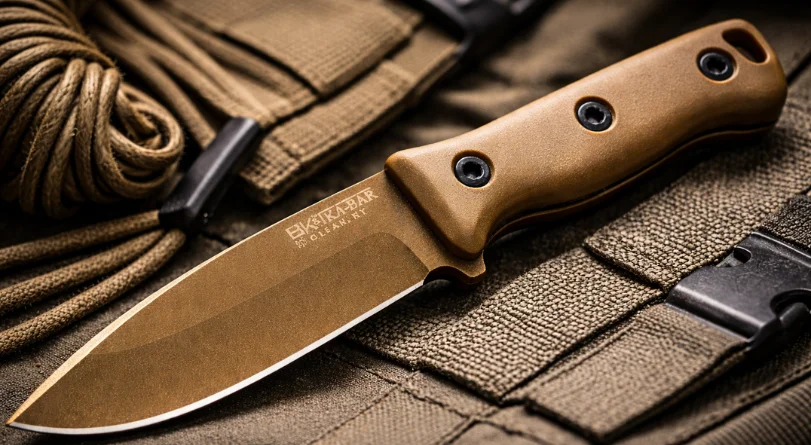
The first thing you notice about the BK18 is the harpoon blade profile. At first glance it looks aggressive — almost tactical — but the design actually serves a functional purpose.
The harpoon hook sits just behind the swedge and ahead of the thumb ramp. In use, I often found myself placing my thumb or forefinger into that recess during controlled carving. It provides a surprising amount of leverage when shaping notches or feather sticks.
The blade geometry works well for a compact field knife:
- Long belly for slicing
- Swedge near the tip for piercing
- High saber grind for durability
- Thick spine for batoning
The saber grind leaves plenty of steel behind the edge. That adds durability during tasks like batoning and light chopping. On a knife under five inches, this is a smart balance between cutting performance and toughness.
For steel, the BK18 uses 1095 Cro-Van, the same alloy used across most of the Becker line.
Characteristics of this steel include:
Toughness: Outstanding impact resistance. Batoning through hardwood rarely phases it.
Edge Retention: Moderate. Not on the level of modern powder steels like CPM S30V, M390, or CPM MagnaCut, but still perfectly acceptable for field use.
Corrosion Resistance: Low. Like most high-carbon steels, it requires basic maintenance.
Sharpening: Very easy. This is one of the biggest advantages of 1095-based steels. Even a small field stone will restore a working edge.
The blade ships with KA-BAR’s black traction coating. It helps with corrosion resistance but introduces two drawbacks:
- It collects dirt and grime during extended outdoor use
- It prevents the spine from striking sparks from a ferro rod
Many users simply sand a small section of coating off the spine to fix this.
Handle Ergonomics
The BK18 ships with Zytel handle scales, a glass-filled nylon polymer that is common across the Becker lineup.
While I personally prefer Micarta, the Zytel scales perform better than expected in real use.
Strengths of the handle:
- Excellent palm swell
- Rounded edges eliminate hot spots
- Secure grip when wet
- Down-turned pommel improves chopping leverage
The ergonomic shape is where the BK18 really shines. After long carving sessions, I noticed very little hand fatigue. That’s not something you can say about many knives in this size class.
The design actually reminds me of the handle ergonomics on the Buck Compadre, another knife known for excellent grip comfort.
If you prefer natural materials, aftermarket Micarta scales are widely available and dramatically improve the tactile feel.
But purely from a performance standpoint, the stock Zytel handles work perfectly well.
Sheath & Carry System
KA-BAR made a major upgrade with the BK18 sheath.
Instead of the older nylon designs used on earlier Becker knives, the BK18 ships with a Celcon polymer sheath. It’s rugged, weather resistant, and significantly more durable in the field.
Key features include:
- Secure snap retention strap
- Large thumb ramp for easy draw
- Multiple lashing points
- Removable belt loop attachment
The knife stays secure even with the snap open, although it can rattle slightly.
One small downside is that the sheath is not fully compatible with Tek-Lok mounting systems. However, you can still mount a Tek-Lok using a combination of lashing holes and slots.
This workaround allows for horizontal (scout) carry, which many users prefer for compact fixed blades.
Overall, the sheath is one of the better factory options KA-BAR has produced.
Ka-Bar Becker BK18 vs The Competition
BK18 vs BK19
The closest alternative is the Ka‑Bar Becker BK19.
Both knives share the same:
- steel
- handle
- sheath system
- overall dimensions
The main difference is blade shape.
The BK19 uses a Nessmuk profile, which offers a broader belly and more traditional bushcraft geometry.
Choose the BK18 if you want: A survival-tactical hybrid with better piercing ability.
Choose the BK19 if you want: A dedicated bushcraft blade.
BK18 vs Morakniv Bushcraft
The Morakniv Bushcraft is a classic outdoor blade and usually costs less.
Advantages of the Mora:
- Better grip in wet conditions
- Ferro rod compatibility
- Lightweight
Advantages of the BK18:
- Full tang construction
- Superior sheath durability
- Better food prep performance
- More versatile blade shape
If you want maximum durability, the BK18 wins.
BK18 vs LionSteel T5
The LionSteel T5 sits in a higher price bracket.
The T5 uses Niolox steel, which dramatically improves edge retention.
However:
- The BK18 handle is arguably more comfortable
- The BK18 excels at food prep
- The price is significantly lower
Choose the T5 for premium steel. Choose the BK18 for value and ergonomics.
Ka-Bar Becker BK18 Pros & Cons
Pros
- Excellent ergonomics with no hot spots
- Versatile harpoon blade design
- Tough 1095 Cro-Van steel
- Outstanding factory sheath
- Great balance between bushcraft and tactical capability
- Made in the USA
Cons
- Traction coating prevents ferro rod sparks
Fix: Lightly sand the coating off a section of the spine.
- Zytel handles feel plasticky to some users
Fix: Upgrade to aftermarket Micarta scales.
- Sheath is not fully Tek-Lok compatible
Fix: Mount Tek-Lok using the lashing holes.
Common Questions About the Ka-Bar Becker BK18
Is the BK18 full tang?
Yes. The BK18 uses a full-tang construction typical of the Becker line. This greatly improves durability during batoning and hard use.
Does 1095 Cro-Van rust easily?
Like most carbon steels, it can rust if neglected. Dry the blade after use and apply a light coat of oil for protection.
Is the BK18 good for bushcraft?
Yes. Despite the tactical appearance, the knife performs very well at:
feather sticking
carving
notching
food prep
Can the BK18 strike a ferro rod?
Not out of the box. The traction coating prevents sparks. Removing a small portion of the coating from the spine fixes the problem.
Is the BK18 good for backpacking?
Absolutely. At 6.8 oz, the knife strikes a good balance between durability and carry weight.
Final Verdict: Ka-Bar Becker BK18 Review
After extensive field use, the Ka-Bar Becker BK18 proves itself to be one of the most versatile knives in the Becker lineup.
- It’s not the best chopper.
- It’s not the most advanced steel.
- And it isn’t a pure bushcraft knife.
But that’s exactly the point.
The BK18 sits right in the middle of the Venn diagram between survival blade, tactical tool, and camping knife.
You get:
- proven 1095 Cro-Van toughness
- excellent ergonomics
- a surprisingly useful harpoon blade design
- one of the best sheaths KA-BAR has produced
For campers, backpackers, and survival enthusiasts who want a compact fixed blade that can handle nearly anything, the BK18 is an easy recommendation.
If you want a durable American-made field knife under $150, the BK18 remains one of the best options available.
Ka-Bar Becker BK18

Summary
The BK18 is ideal for campers, backpackers, bushcrafters, and survival enthusiasts who want a durable, compact fixed blade that performs reliably in real outdoor conditions.
Related Knife: Cold Steel SRK SK-5 Review