
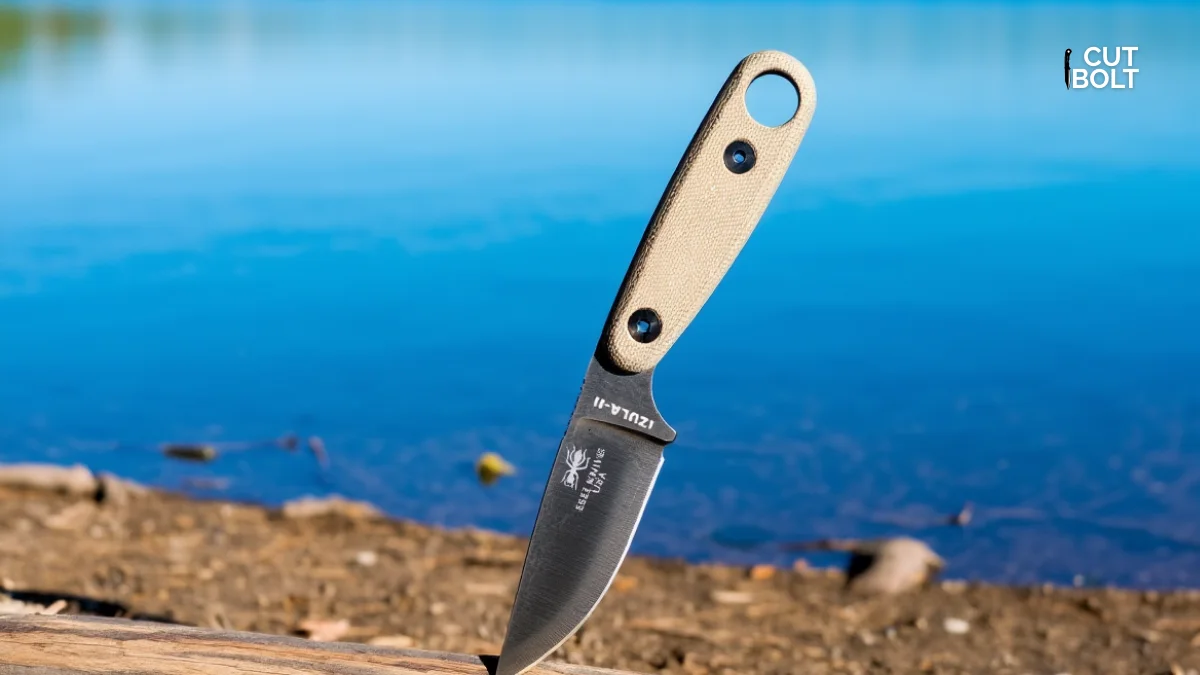

The ESEE Izula II Review begins with a knife that has earned its reputation as one of the toughest, most confidence-inspiring small fixed blades on the market. Designed as a compact survival tool with real pedigree behind it, it feels immediately authoritative yet nimble in the hand.
Built for backpackers, bushcrafters, and minimalist survivalists who prioritize reliability over size, the Izula II behaves like a scaled-down workhorse. The moment you grip it, the textured Micarta scales and stout drop-point profile tell you this is a tool meant to be used—not admired from afar.
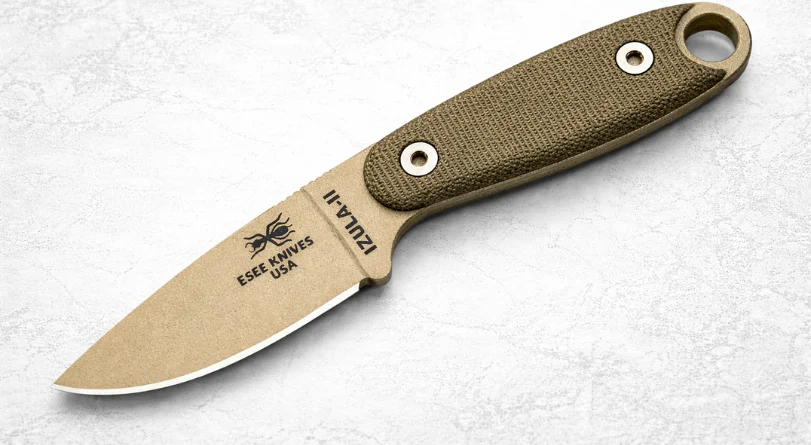
ESEE Uzula II Specifications
| Category | Specification |
| Overall Length | 6.75″ |
| Blade Length | 2.875″ |
| Cutting Edge | 2.625″ |
| Blade Thickness | 0.16″ |
| Blade Material | 1095 Carbon Steel |
| HRC | ~55–57 (typical ESEE heat treat) |
| Blade Style | Drop Point |
| Blade Grind | Flat |
| Finish | Black Stonewashed |
| Handle Material | Micarta |
| Handle Thickness | 0.57″ |
| Weight | 3.30 oz |
| Sheath Type | Injection-Molded Polymer |
| Country of Origin | USA |
Steel & Material Analysis
ESEE’s 1095 is one of the most field-proven carbon steels ever used in bushcraft knives. But the magic isn’t the alloy—it’s the heat treat. ESEE’s mid-range ~55–57 HRC target gives the Izula II a balance few small knives achieve.
This hardness keeps the grain structure fine enough for a toothy, aggressive edge while preventing brittleness during prying or splitting tasks. The lower wear-resistance of 1095 means it won’t hold an edge like high-vanadium steels, but the trade-off is predictable behavior, high toughness, and very forgiving sharpening characteristics.
Carbide volume remains modest, so micro-chipping is rare, even when carving knotty wood or striking a ferro rod.
Blade Design & Geometry
The drop-point blade gives the Izula II excellent control, especially for detail tasks like feather sticks, notching traps, or processing tinder. The tip has enough meat to survive moderate lateral load without feeling blunt or over-built.
Its full flat grind provides efficient slicing for a small blade, and the .16″ spine thickness adds strength when batoning small branches or splitting kindling. While the blade is short, the consistent grind geometry makes it feel larger during controlled push cuts.
A modest distal taper supports fine tip work without creating a fragile needle point.
Build Quality & Fit/Finish
ESEE’s build quality is consistently high, and the Izula II reflects that. The Micarta scales feel cleanly shaped with smooth transitions to the tang—no proud edges, no gaps, no machining chatter.
The powder-coated/stonewashed finish is evenly applied and thick enough to protect the steel without feeling gummy. The spine edges stay rough enough to grab a ferro rod, while the choil area is machined cleanly and free of burrs.
Hardware remains tight, well-seated, and doesn’t loosen with vibration, even with heavy field use.
Edge Retention & Sharpening Experience
Expect moderate edge retention. On cardboard and wood, the Izula II maintains a working edge for a fair amount of time but won’t compare to high-end powdered steels. This is the reality of 1095 at a toughness-focused heat treat.
The reward is easy maintenance. The blade sharpens beautifully on basic stones—even river rocks in a pinch—and responds quickly to strops. Diamond plates are optional, not mandatory.
For field use, this is exactly what most outdoorsmen want: predictable, fast touch-ups.
Sheath & Carry System
The included injection-molded polymer sheath is one of the best in the small-fixed-blade category. Retention is crisp; the knife seats with an audible click and remains secure with no rattle.
Carry options are flexible thanks to the ambidextrous clip plate. It can be worn scout style, vertical, horizontal, or lashed to a shoulder strap or pack. The sheath’s drainage and durability make it well suited for wet environments.
The draw is smooth and fast, ideal for backpacking or concealed carry.
Weight, Balance & Ergonomics
At 3.30 oz, the Izula II practically disappears on the belt. Balance remains neutral—slightly toward the handle, which improves control for carving.
The Micarta scales swell gently into the palm, offering reliable grip even when wet. Hammer grip and pinch grip feel natural, and reverse grip remains usable thanks to the subtle tail flare.
Hot spots are minimal, though prolonged hard carving may introduce pressure near the rear tang if your hands are very large.
Durability & Hard Use
As a full-tang knife built from robust 1095 stock, the Izula II tolerates abuse far better than its size suggests. It handles batoning small branches, scraping bark, and prying in survival tasks without fear of catastrophic failure.
That said, it is still a small blade. Lateral prying on large objects or hammering through big knots will exceed its intended design. Within reasonable limits, it behaves like a compact tank.
Rust & Corrosion Resistance
1095 requires real maintenance. The blade finish helps, but any exposed steel—especially the edge—will rust if left wet.
In humid or coastal environments, a dry film like TUF-GLIDE or TUF-CLOTH becomes essential. Wipe and oil the edge regularly, especially after cutting acidic materials or using it in wet weather.
With basic care, corrosion is manageable and rarely problematic.
Price vs. Performance (Value Proposition)
In its price tier, the Izula II delivers outstanding value. You’re paying for premium heat treatment, rugged construction, a real warranty, and an excellent sheath—not marketing fluff.
Most competitors at this size either cut corners on steel treatment or include lackluster sheaths. ESEE doesn’t. As a small fixed blade meant for real use, the Izula II sits in the top of its category for value and reliability.
Pros & Cons
Pros
- Exceptional toughness for a small knife
- Comfortable Micarta handles
- Excellent polymer sheath with strong retention
- Easy to sharpen in the field
- Neutral balance and high control for bushcraft tasks
- Legendary ESEE warranty
Cons
- 1095 requires diligent rust prevention
- Edge retention is only moderate
- Blade length limits utility for larger camp tasks
- Slightly bulky sheath footprint compared to ultralight options
Final Verdict: ESEE Izula II Review
The ESEE Izula II is a compact, hard-use fixed blade built for real outdoorsmen—not collectors. It’s a trustworthy tool for backpackers, survivalists, and bushcrafters who need a small knife that punches above its weight.
It’s not an ultralight hiker’s minimalist scalpel, nor is it meant to replace a full-sized camp knife. Instead, it excels as a durable EDC fixed blade, a backup survival knife, or the primary cutter in a small bug-out kit.
For anyone who values reliability, toughness, and simple field maintenance, the Izula II stands as one of the strongest choices in the small-knife category.
ESEE Knives Izula-II Fixed Blade Knife Review
Summary
This knife is ideal for backpackers, bushcrafters, and survival-minded outdoorsmen who want a compact but extremely tough fixed blade for everyday field use.
Check our guide for best survival knives.