


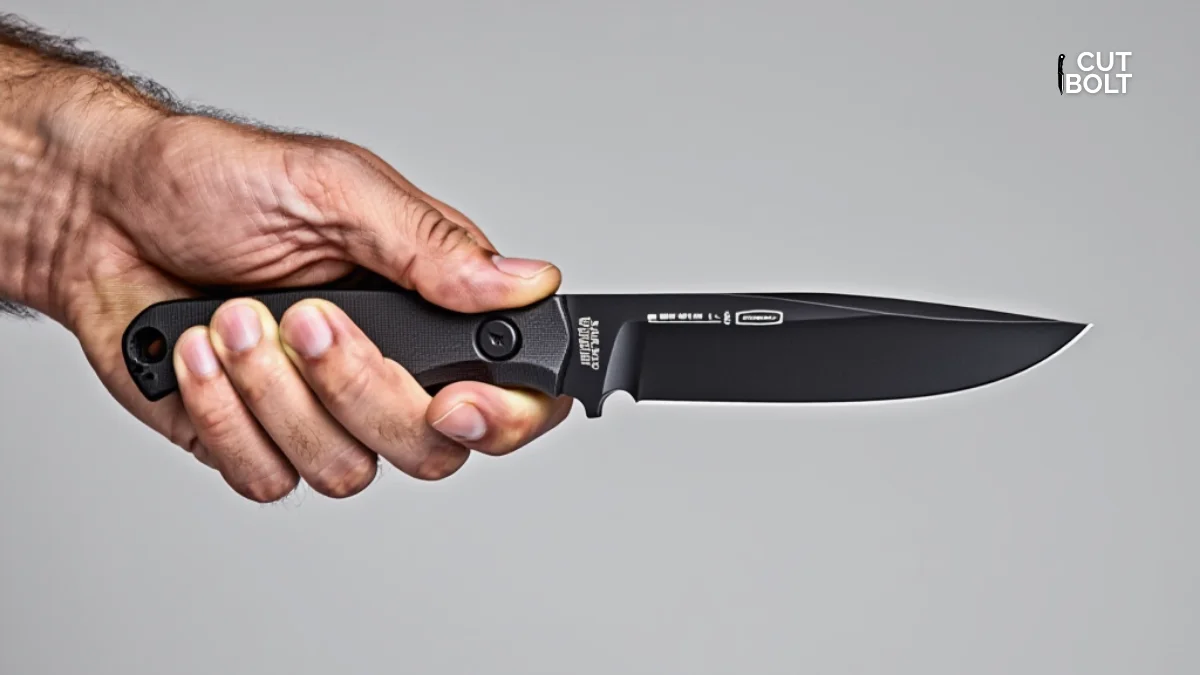
The Ka-Bar Ek Commando Short Clip Point is a modern reinterpretation of a historic fighting knife, redesigned to function as a practical utility blade for real-world outdoor use. After spending time with the knife during camp chores and light bushcraft work, my takeaway is simple: this is a compact, tough field knife with real versatility—though the handle material won’t appeal to everyone.
The knife blends the legacy of the original WWII Ek Commando designs with Ka-Bar’s proven approach to durable field knives. I tested it during routine outdoor tasks including carving stakes, splitting kindling, and general campsite cutting.
In this review we’ll look at the blade geometry, how the 1095 Cro-Van steel performs, ergonomics, sheath design, and where the knife fits compared to other tactical utility blades.
Quick Verdict
Rating: 4.9 / 5
Best For
- Military or tactical users needing a compact fixed blade
- Campers who want a tough lightweight belt knife
- Collectors interested in the Ek Commando lineage
Not Ideal For
- Users who prefer thick ergonomic handles
- Heavy-duty prying or chopping tasks
Typical Price Range: $80–$120
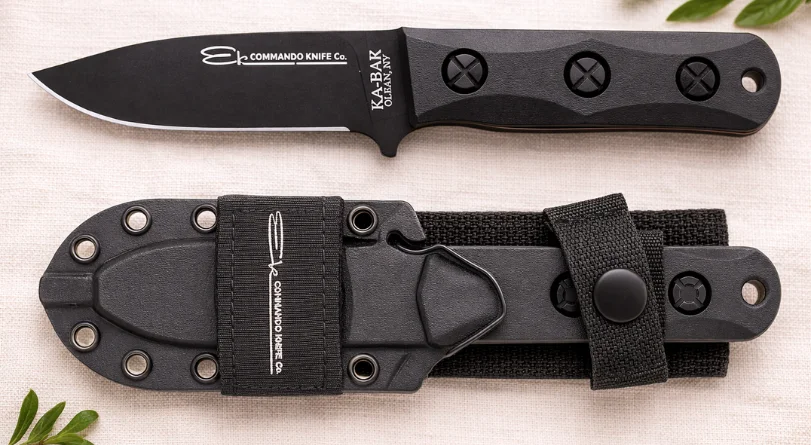
Specifications of Ka-Bar Ek Commando
| Specification | Details |
| Overall Length | 9.25 in |
| Blade Length | 5.06 in |
| Blade Thickness | 0.165 in |
| Blade Steel | 1095 Cro-Van |
| Blade Shape | Clip Point |
| Grind Type | Flat Grind (20°) |
| Handle Material | Ultramid (glass-filled nylon) |
| Weight | 10.4 oz (0.65 lb) |
| Sheath | Kydex with nylon back |
| Country of Origin | USA |
Ka-Bar Ek Commando Design Background
The original Ek Commando knives were designed by John Ek during World War II for American special operations units.
Unlike many dagger-style fighting knives of the era—such as the Fairbairn-Sykes—Ek knives prioritized durability and practicality. They featured strong blades, simple slab handles, and exposed tang sections for striking or prying.
After the Ek brand changed ownership several times, Ka-Bar eventually acquired the line, introducing updated materials and more versatile blade designs.
The Short Clip Point represents this modern direction: still tactical in spirit, but designed as a usable field knife rather than a pure fighting dagger.
Blade Design & Geometry of Ka-Bar Ek Commando
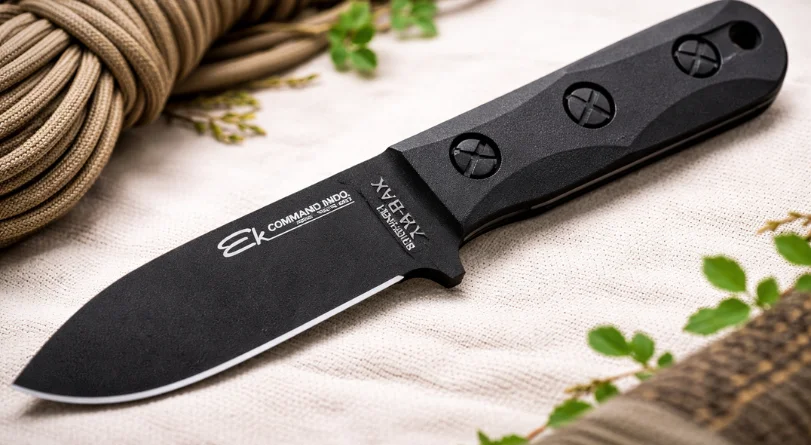
The clip point blade immediately sets this knife apart from the traditional double-edged Ek models.
Clip point geometry creates a sharper, more aggressive tip, which is excellent for piercing tasks while still maintaining enough belly for slicing. This shape is common in Bowie-style knives because it balances precision with cutting power.
The flat grind runs most of the height of the blade. In practical terms, this gives the knife:
- Good slicing performance
- Thin enough edge geometry for rope and cardboard
- Better food prep capability than traditional combat daggers
At 0.165 inches thick, the blade sits in the sweet spot for outdoor knives. It’s thick enough for moderate batoning and camp chores but not so thick that it becomes a wedge when slicing.
One interesting detail is that Ka-Bar retained a reinforced spine section near the clip, which helps preserve tip strength during harder tasks.
Ka-Bar Ek Commando Blade Steel Performance
The blade uses 1095 Cro-Van, a classic carbon steel that Ka-Bar has used for decades.
In real-world use, this steel prioritizes durability and ease of maintenance.
- Toughness: 1095 Cro-Van is extremely tough. It handles impact well and is unlikely to chip during tasks like batoning or carving.
- Edge Retention: Edge retention is moderate. It won’t hold an edge as long as premium steels like S30V or M390, but it stays sharp long enough for typical camp work.
- Corrosion Resistance: This is the main trade-off. 1095 is not stainless, so it can rust if neglected. Fortunately, Ka-Bar typically coats their blades to slow corrosion.
- Ease of Sharpening: This is where 1095 shines. It sharpens quickly—even on a basic field stone.
Compared to modern steels like MagnaCut or S30V, 1095 sacrifices corrosion resistance and long edge life, but it gains toughness and extremely easy field sharpening, which is why many survival knives still use it.
Ka-Bar Ek Commando Field Testing Performance
To see how the knife performs outside of specifications, I used it during several typical outdoor tasks.
Initial Sharpness
Out of the box, the knife was very sharp.
It sliced paper cleanly and cut through paracord with minimal pressure.
The edge geometry feels optimized for practical cutting rather than just piercing.
Batoning Kindling
During one camping trip I used the knife to split several pieces of seasoned oak roughly three to four inches thick for kindling.
Despite the relatively slim blade, the knife handled the batoning easily. The edge showed no chips or rolls afterward.
The full tang construction inspires confidence during these tasks.
Feather Sticks and Wood Carving
Feather sticking is often a good test of blade control.
While working with dry pine branches, the knife produced thin curls easily thanks to the flat grind and sharp edge.
The clip point tip also allowed precise cuts, which made carving tent stake notches easy.
Rope and Utility Cutting
This knife excels at general cutting tasks.
I used it for:
- cutting paracord
- slicing cardboard
- trimming small branches
The blade geometry bites aggressively into fibrous materials.
Food Prep at Camp
Many tactical knives struggle with food prep, but the Ek Commando performs better than expected.
During a weekend trip I used the knife to slice apples, sausage, and cheese.
The blade shape provides enough belly for slicing, though it’s still primarily designed as a utility knife.
Field Testing Summary
After several outdoor trips and routine camp chores, here’s how the Ka-Bar Ek Commando Short Clip Point performed across common knife tasks.
| Task | Performance | Notes |
| Initial Sharpness | ★★★★☆ | Arrived shaving sharp and sliced paper and paracord cleanly right out of the box. |
| Wood Batoning | ★★★★☆ | Handled splitting small oak and pine kindling without edge damage. Best suited for moderate batoning rather than heavy wood processing. |
| Feather Sticks | ★★★★☆ | The flat grind and sharp edge made feather sticks easy to produce with good control near the tip. |
| Carving Control | ★★★★☆ | Clip point tip allowed precise cuts for notching tent stakes and shaping small sticks. |
| Rope & Utility Cutting | ★★★★★ | Excellent performance on rope, cardboard, and fibrous materials thanks to the thin edge geometry. |
| Food Prep | ★★★☆☆ | Works fine for simple camp food prep like slicing apples or sausage, though the blade shape is still more tactical than kitchen-oriented. |
| Edge Retention | ★★★☆☆ | Typical 1095 performance—holds an edge through normal camp tasks but benefits from occasional touch-ups. |
| Handle Comfort | ★★★☆☆ | Secure grip with scalloped grooves, but the narrow Ultramid handle may feel small for users with large hands. |
Overall Field Performance
The Ka-Bar Ek Commando Short Clip Point performs best as a lightweight belt knife for camp and field use. It excels at utility cutting tasks while still being tough enough for moderate outdoor chores like carving, feather sticking, and splitting small kindling.
Ka-Bar Ek Commando Handle Ergonomics
The Ultramid handle scales are made from glass-filled nylon.
This material is extremely durable and lightweight, but it lacks the warmth and grip feel of materials like micarta or G-10.
The handle is fairly narrow, which gives the knife a nimble feel but may feel small for users with large hands.
Positive features include:
- scalloped finger grooves
- textured surface
- lightweight balance
The scalloped cuts actually lock the hand in place surprisingly well.
However, the minimal guard means you’ll want to maintain a secure grip during thrusting or hard push cuts.
If there’s one design element I’d change, it would be upgrading the handle material.
Sheath & Carry Options
Ka-Bar ships the knife with a Kydex sheath mounted to a nylon backer.
Retention is excellent. The knife locks into place with a noticeable snap and requires a deliberate draw.
Features include:
- belt loop attachment
- modular mounting options
- drainage hole at the bottom
The drain hole is a nice touch for wet environments.
The sheath is also slim and low-profile—another sign this knife was designed as a practical field tool rather than a flashy tactical piece.
Ka-Bar Ek Commando Comparisons with other knives
We have compared few popular knives in same category of Ka-Bar Ek Commando that will help you:
Ka-Bar EK44
The EK44 is another modern Ka-Bar Ek model.
Differences:
- Longer blade
- More traditional Ek fighting style
- Less compact for camp use
The Short Clip Point is better for general outdoor tasks.
ESEE 4
The ESEE 4 is one of the most popular survival knives in this size class.
Differences:
- thicker blade
- micarta handle scales
- heavier construction
The ESEE is more robust, but the Ka-Bar is lighter and faster in hand.
Benchmade Nimravus
The Nimravus is a tactical fixed blade in a similar size.
Differences:
- premium stainless steel
- higher price
- lighter blade geometry
The Nimravus offers better corrosion resistance but less toughness than 1095.
Ka-Bar USMC Fighting Knife
The classic USMC Ka-Bar is another historic military blade.
Differences
USMC Ka-Bar
- longer blade
- stacked leather handle
- designed for combat utility
Ek Commando
- shorter
- more compact
- modern materials
The Ek feels more practical for everyday carry around camp.
Ka-Bar Ek Commando Short Clip Point vs Original WWII Ek Commando Knife
The Ka-Bar Ek Commando Short Clip Point is inspired by the historic Ek Commando knives carried by American special operations troops during World War II. While the modern version keeps the spirit of the original design, the two knives were built with very different priorities.
The original Ek knives were pure fighting tools, while the modern Ka-Bar version is designed as a versatile field knife that can also serve defensive roles.
Key Differences:
| Feature | WWII Ek Commando Knife | Ka-Bar Ek Commando Short Clip Point |
| Primary Purpose | Close-quarters combat | Tactical utility / outdoor use |
| Blade Type | Double-edged dagger | Clip point utility blade |
| Blade Length | Often 6–7 inches | 5.06 inches |
| Blade Geometry | Diamond cross-section | Flat grind |
| Steel | Carbon or early stainless variants | 1095 Cro-Van carbon steel |
| Handle | Maple or Micarta slabs | Ultramid (glass-filled nylon) |
| Tang Feature | Often exposed tang for prying | Full tang without pry extension |
| Sheath | Leather or simple nylon | Kydex with nylon backing |
Blade Design Evolution
The biggest change between the original Ek Commando knife and the modern Ka-Bar version is the blade design.
The WWII models were typically double-edged daggers designed for stabbing and deep penetration. Their diamond-shaped cross section made the blade strong along the centerline but limited slicing performance.
The Ka-Bar Ek Commando Short Clip Point replaces that dagger blade with a clip point profile and flat grind.
This change dramatically improves:
- slicing ability
- wood carving control
- rope and utility cutting
While the original knife was optimized for combat, the modern design functions much better as a general-purpose outdoor knife.
Materials and Construction Changes
Another major difference is the materials used.
Early Ek knives often used maple wood handles secured with poured lead rivets. While functional, these handles could loosen or degrade over time.
The modern Ka-Bar version uses glass-filled nylon (Ultramid) scales secured with bolts, which improves durability and allows the handle to be removed for cleaning or replacement.
Blade steel has also evolved. The Ka-Bar model uses 1095 Cro-Van, a tough carbon steel that performs well in outdoor tasks and is easy to sharpen in the field.
Practical Use Differences
In practical terms, these knives serve different roles.
The WWII Ek Commando knife was designed primarily for stealth combat and close-quarters fighting. Soldiers carried it as a dedicated weapon.
The Ka-Bar Ek Commando Short Clip Point, however, is more of a compact field knife. It can handle tasks such as:
- carving tent stakes
- preparing kindling
- cutting rope and webbing
- general campsite chores
It still retains the aggressive tip and tactical appearance of the original design, but its real strength lies in everyday outdoor utility.
Best Alternatives to the Ka-Bar Ek Commando Short Clip Point
The Ka-Bar Ek Commando Short Clip Point sits in an interesting category: a lightweight tactical fixed blade that can also serve as a practical outdoor utility knife. If you like the concept but want something slightly different in size, handle material, or overall durability, there are a few strong alternatives worth considering.
Below are three knives that compete closely with the Ek Commando in terms of size, intended use, and price.
ESEE 4
The ESEE 4 is one of the most respected survival knives in the 4–5 inch blade category. It’s designed primarily as a hard-use outdoor tool rather than a fighting knife.
Compared to the Ek Commando, the ESEE 4 has a thicker blade and heavier construction, making it better suited for demanding bushcraft tasks like heavy batoning and carving hardwood.
However, the Ek Commando has advantages in weight and agility. It feels faster in hand and carries more comfortably on a belt during long hikes.
Choose the ESEE 4 if you want maximum durability for bushcraft and survival work.
Choose the Ek Commando if you prefer a lighter tactical utility knife.
Ka-Bar USMC Fighting Knife
The Ka-Bar USMC Fighting Knife is one of the most iconic military knives ever made. Originally issued to Marines during World War II, it remains popular with collectors and outdoor users today.
Compared with the Ek Commando Short Clip Point, the USMC Ka-Bar features a longer blade and thicker stacked leather handle, giving it a more traditional combat-utility design.
The downside is that the USMC knife is noticeably larger and heavier, which makes it less convenient as a compact belt knife.
If you want a historic combat knife with a larger blade, the USMC Ka-Bar is a classic choice.
If you prefer a lighter, more compact field knife, the Ek Commando is easier to carry and control.
Benchmade Nimravus
The Benchmade Nimravus is a modern tactical fixed blade designed for military and law enforcement use. It shares the Ek Commando’s focus on lightweight carry and versatility but uses premium materials.
Most versions of the Nimravus feature premium stainless steels, which offer better corrosion resistance and longer edge retention compared to traditional carbon steels.
The trade-off is price. The Nimravus typically costs significantly more than the Ek Commando.
Choose the Benchmade Nimravus if you want premium materials and modern design.
Choose the Ek Commando if you want a tough, historically inspired knife at a lower price point.
How the Ek Commando Stacks Up
When compared to these knives, the Ka-Bar Ek Commando Short Clip Point stands out for three main reasons:
- Lightweight design – easier to carry than many survival knives
- Historic lineage – derived from WWII special operations knives
- Balanced utility – capable of both tactical and camp tasks
It may not be the thickest or most premium knife in its class, but it strikes a very appealing balance between heritage, practicality, and affordability.
Pros & Cons of Ka-Bar Ek Commando
Pros:
- Tough 1095 Cro-Van steel
- Lightweight and balanced design
- Excellent slicing ability for a tactical knife
- Strong historical design heritage
- Versatile Kydex sheath
Cons:
- Ultramid handle feels less premium
- Minimal guard for thrusting tasks
- Not designed for prying
Should You Buy Ka-Bar Ek Commando Knife?
The Ka-Bar Ek Commando Short Clip Point is ideal for:
- military or law enforcement users
- hikers wanting a lightweight belt knife
- collectors of historic combat knife designs
You may want to skip it if:
- you prefer thicker ergonomic handles
- you need a heavy-duty survival knife for extreme abuse
For general camp use with tactical heritage, it performs very well.
Frequently Asked Questions About Ka-Bar Ek Commando Knife
Is the Ka-Bar Ek Commando Short Clip Point primarily a fighting knife?
The Ka-Bar Ek Commando Short Clip Point traces its origins to WWII fighting knives designed for close-quarters combat. However, the modern Ka-Bar version is built with a more versatile blade shape and grind, allowing it to function as a practical utility knife for camp chores, cutting rope, carving wood, and other everyday outdoor tasks while still retaining defensive capability if needed.
Can the Ka-Bar Ek Commando Short Clip Point baton wood?
Yes, the Ka-Bar Ek Commando Short Clip Point can handle moderate batoning tasks thanks to its full tang construction and tough carbon steel blade. During normal camp use, it works well for splitting small pieces of kindling or processing firewood for a campfire. That said, it’s not designed as a large survival chopper, so extremely thick or knotty wood should be avoided.
Is the handle removable on the Ka-Bar Ek Commando Short Clip Point?
Yes, the Ka-Bar Ek Commando Short Clip Point features removable handle scales secured with large bolts instead of permanent rivets. This allows users to take the scales off for cleaning, maintenance, or replacement. It’s a useful feature if dirt, moisture, or debris accumulates under the scales during extended outdoor use or harsh field conditions.
Is the Ka-Bar Ek Commando Short Clip Point made in the USA?
Yes, the Ka-Bar Ek Commando Short Clip Point is manufactured in the United States. Ka-Bar produces these knives using domestic manufacturing processes, maintaining a connection to the original Ek Commando knives that were developed during World War II for American military personnel and special operations units.
Is the Ka-Bar Ek Commando Short Clip Point good for camping and outdoor use?
Yes, the Ka-Bar Ek Commando Short Clip Point works very well as a lightweight camp knife. The five-inch blade is long enough for tasks like feather sticking, carving tent stakes, and food prep, while still being compact enough to carry comfortably on a belt during hiking or paddling trips. Its balanced size makes it practical without feeling bulky.
How does the Ka-Bar Ek Commando Short Clip Point compare to the classic Ka-Bar USMC knife?
The Ka-Bar Ek Commando Short Clip Point is noticeably smaller and lighter than the classic Ka-Bar USMC fighting knife. While the USMC model has a longer blade and thicker handle designed for combat utility, the Ek Commando feels more compact and agile. Many users find it easier to carry daily around camp or on hiking trips.
Is the Ka-Bar Ek Commando Short Clip Point comfortable for extended use?
The Ka-Bar Ek Commando Short Clip Point is surprisingly comfortable despite its relatively slim handle design. The scalloped finger grooves provide solid grip security, and the textured Ultramid scales prevent slipping in wet conditions. However, users with very large hands may find the handle slightly narrow during prolonged carving or heavy cutting tasks.
Is the Ka-Bar Ek Commando Short Clip Point worth buying today?
For users who appreciate military knife history and want a practical fixed blade, the Ka-Bar Ek Commando Short Clip Point offers a strong balance of heritage and functionality. It’s tough, lightweight, and easy to maintain, making it a solid option for campers, hikers, first responders, or anyone looking for a versatile belt knife.
What is the blade length of the Ka-Bar Ek Commando Short Clip Point?
The Ka-Bar Ek Commando Short Clip Point features a blade length of approximately 5.06 inches, giving it a balanced size for both tactical and outdoor utility tasks. This length provides enough cutting surface for camp chores such as carving, slicing rope, or preparing food while still remaining compact and easy to carry on a belt.
Is the Ka-Bar Ek Commando Short Clip Point good for everyday carry?
The Ka-Bar Ek Commando Short Clip Point can work well as a fixed blade for everyday carry, especially for users who prefer belt knives over folding knives. Its compact size, lightweight design, and slim Kydex sheath make it relatively comfortable to carry during hiking, camping, or outdoor work without feeling overly bulky.
Why is the Ka-Bar Ek Commando Short Clip Point popular among tactical knife users?
The Ka-Bar Ek Commando Short Clip Point remains popular because it combines historic military design with modern materials and practicality. Its strong full tang construction, tough carbon steel blade, and lightweight profile make it a dependable tool for both field use and defensive roles while still honoring the original Ek Commando knife heritage.
Final Verdict: Ka-Bar Ek Commando Short Clip Point
The Ka-Bar Ek Commando Short Clip Point is a thoughtful evolution of a historic fighting knife.
By switching to a clip point utility blade and flat grind, Ka-Bar transformed the design into a practical outdoor tool while still preserving the spirit of John Ek’s original knives.
It’s lightweight, tough, and capable of handling most camp chores without issue.
The handle material may divide opinions, but overall this knife offers excellent value and real-world functionality.
If you appreciate military knife history and want a practical fixed blade, this one is worth a look.
Check current pricing for the Ka-Bar Ek Commando Short Clip Point at major knife retailers.
KA-BAR EK Commando Fixed Blade Knife
Summary
This knife is ideal for campers, hikers, tactical users, and collectors of military knife history who want a lightweight fixed blade that balances utility performance with the heritage of the original Ek Commando design.
Performance Scorecard
- Build Quality: 4.5 / 5
- Cutting Performance: 4.2 / 5
- Ergonomics: 3.8 / 5
- Value for Money: 4.4 / 5
Overall Rating: 4.2 / 5
Related Knife Guides: